
Bass Review - Spector Euro Classic
Updated: Jun 10

Spector basses have a well-established and well-deserved reputation as great playing, versatile, professional level instruments. The original Spector NS-1 bass was developed by Stuart Spector and Ned Steinberger in 1977, followed by the NS-2 in 1979. The NS basses featured a carved, ergonomically contoured design, neck-through body construction, high-mass bridges, and active electronics. These instruments quickly became the standard for modern bass tone - clear and articulate, with a punchy top end, ample lows, and tons of sustain, all with zero noise thanks to the ultra-quiet EMG pickups. Spector basses were absolutely prolific during the 80's and 90's - favored by players from Sting to Rex Brown and heard on studio hits from Madonna's "Like a Prayer," to Metallica's "Enter Sandman." While Spector began as a strictly US manufacturer of basses (and still offers custom US made instruments today), by the mid 80's they had begun offering less expensive production models made in Asia and Czechoslovakia. While less expensive than the USA custom instruments, the Spector Euro series basses are far from being a budget bass - with retail prices starting around $3000, they are fully featured, professional basses made to the highest standard by experienced craftsmen.
Spector's Euro series encompasses a range of features and aesthetics, from vintage to ultra-modern. The Euro Classic series is the closest to the original NS-2 basses made popular in the late 70's and early 80's. We recently got a 4 and a 5 string model in matching Metallic Gold, which seemed as good an excuse as any to write up a review of the sounds and features of these basses.

Pickups and Electronics
Spector offers a range of pickup and preamp options from makers such as Aguilar, Darkglass, but EMG pickups are traditional choice most closely associated the Spector sound. The Euro Classic 4 string sports an EMG ceramic P/J pickup set, while the 5 string features a J/J set. Both pickup sets sound great, with plenty of output and clarity with zero noise. The inclusion of the P pickup gives a distinct growl and broader midrange character to the Euro 4, while the matched J pickups give the 5 string a more mid-scooped tone with both pickups activated. Each instrument sports an EMG BTS preamp with volume, pickup blend, and bass and treble EQ. The EMG preamp is dialed in beautifully. The bass and treble controls can both boost and cut frequencies, and are fully usable throughout each knob's rotation - there are no bad sounds on these basses. It is quick and intuitive to dial up a scooped slap tone, aggressive rock tone, or mellow jazz tone. The preamp also features internal dip switches that allow for four different frequency ranges for the treble control.
There are some downsides to the electronics on the Spector Euro Classic. The fact that the pickups are active means that a 9V battery is required for the bass to operate. The current draw of EMG pickups is very low - a battery can last thousands of hours - but it does make for a potential headache not present with passive pickups. Spector does make battery changes easy with a convenient battery door. Additionally, the high-fidelity and broad frequency response of the EMG electronics does give the Euro Classic a distinctly "modern" sound that may not be preferred by all bassists. While these differences would likely go unnoticed in a mix, especially with the right application of EQ, the Euro Classic won't sound exactly like a vintage Fender Precision bass or a Hofner under close scrutiny. That said, the Euro Classic does a much better job of sounding like a vintage Fender bass than a Fender bass does of sounding like a Spector. Like all great instruments, Spector basses have their own sound that is at once distinct but also versatile - leaning into the tones the bass does most naturally is the most rewarding way to play it.

Neck and Body
The Spector Euro Classic Basses feature all-maple construction. The neck is three pieces of maple capped with a rosewood fingerboard, and runs the full length of the body. This construction not only gives the neck a great deal of dimensional stability, but allows the bass to be constructed without a neck heel - which makes playing on the higher frets very comfortable. While maple is an exceptionally strong wood well suited to instrument making, it is also very heavy. To counteract maple's heaviness, the bodies of the Euro Classic basses are weight-relieved, which keeps the weight on these basses quite reasonable (the 4 string bass we have in the shop comes in at a respectable 8 lbs, 10 oz). The lighter weight, combined with the contoured NS body shape makes these basses very comfortable to play. Although Spector produces a range of transparent finishes for their other Euro basses, the Euro Classics are only available in solid colors. As of this writing, the Euro Classics are available in gloss black, gloss white, metallic gold, and metallic blue. All of these finishes look great, but it would be nice if these basses were offered in a transparent finish, especially since maple is an attractive, classy-looking wood - Rickenbacker can't be the only guitar company to have latched on to this idea. The rosewood fingerboard has an even, chocolate-brown color with 24 frets and mother-of-pearl inlays in the classic Spector "crown" shape. The neck has comfortable carve with good playability and a very slight taper from the nut to the body. While not overly so, the necks are on the thick side - Rickenbacker players will be right at home as will Fender enthusiasts. Players accustomed to ultra-thin Ibanez necks may find need an adjustment period to get comfortable with these basses, especially the 5 string. Playability on both basses was excellent right out of the box - neither required any setup work.
Hardware
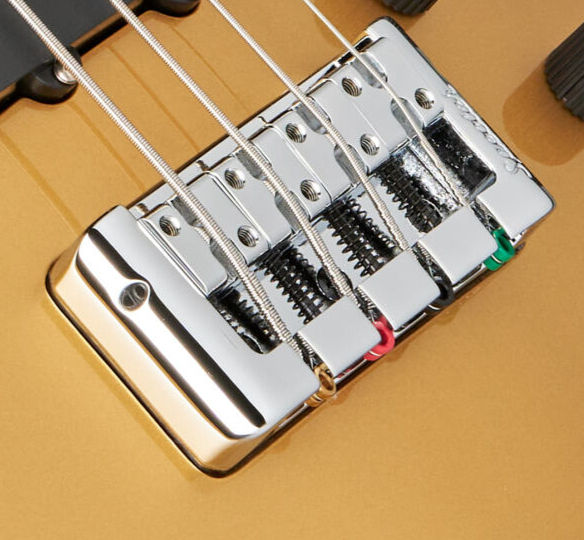
The hardware on the Euro Classic basses is well designed, and impeccably finished. The brass nut is well-fitted to the neck, perfectly cut, and polished to a high shine. The traditional brass bridge has been swapped out for aluminum, which helps keep the wight manageable on these instruments while preserving tone. Another improvement on the newer Spector bridge is the inclusion of intonation adjustment screws, which are absent on older Spectors. While the older design worked well, the newer design allows for easier adjustment and prevents accidental dislodging of the bridge saddles. Retained from the older bridge design are the set screw, which locks all the saddles together for increased resonance, and the slotted string retainers, which facilitate easy string changes.
The B String
The most notable difference between the Euro Classis basses and the rest of the Spector lineup is evident on the 5 string model: the Euro Classic is a standard 34" scale while all of Spector's other 5 string offerings feature an extended 35" scale. The intent of the 35" scale is to provide extra string tension to improve the clarity and intonation of the low B string. This concept certainly works, and the 35" B string on most Spectors sounds great even when de-tuned. The 34" B string on the Euro Classic is worth a serious look though, as it sounds excellent. It requires a little more care be taken in string selection, especially for down-tuned playing, but it definitely no slouch in the bottom registers. The 34" scale does provide a couple of advantages over the 35" scale. One plus is a more familiar feel for players transitioning from 4 string bass or from other bass brands that use a 34" scale on their five strings. Another advantage is that upper fret access is improved on the 34" scale as the 35" scale basses have neck shifted about an inch inward toward the body to accommodate the extra string length.
I hope this was an interesting read for you bass enthusiasts out there, and maybe helps on your tone-questing journey.
Matt, Central Ohio Music


Comments